If someone sends you “WTV”, the most common meaning is “whatever.” In texting, WTV mean in text can mean “I don’t mind,” “you choose,” “I don’t care,” or “I’m done discussing this.” The exact meaning depends on the conversation, the sender’s tone, and what happened before the message.
That’s why one tiny abbreviation can feel surprisingly confusing. A friend might text “wtv works 😂” and sound completely relaxed. Someone replying “WTV.” during an argument can sound irritated or dismissive.
So, if you’re wondering what WTV means in text, start with “whatever.” Then look at the context before deciding what the sender really meant. Dictionary.com also lists WTV as a short form of “whatever” used in texting and chat.
You Got “WTV” and Now You’re Wondering If You Messed Up
Getting a one-word reply can make your brain fill in the blanks.
Maybe you asked, “Do you want pizza or burgers?” They answered, “WTV.” That probably means they have no preference.
Now imagine you apologized after an argument and received the same reply. Suddenly, “WTV” feels much colder.
The abbreviation hasn’t changed. The situation has.
Text messages remove many clues that normally shape meaning. You can’t hear the sender’s voice or see their facial expression. Because of that, words such as “whatever” can sound friendly, bored, sarcastic, annoyed, or dismissive.
Before assuming someone is upset, check three things:
- What did you say immediately before WTV?
- How does that person normally text you?
- Did they add punctuation, emojis, or extra words?
Those clues often tell you more than the abbreviation itself.
Breaking Down What WTV Really Sounds Like
At its core, WTV means “whatever.” It works as informal texting shorthand that saves time and keeps digital conversations brief. Current slang references consistently identify “whatever” as its dominant texting meaning.
However, “whatever” itself carries several shades of meaning. WTV can communicate:
| Meaning | What the sender may mean | Typical tone |
|---|---|---|
| No preference | “Either option works.” | Neutral |
| Indifference | “I don’t really care.” | Casual |
| Acceptance | “You decide.” | Easygoing |
| Frustration | “I’m tired of this.” | Irritated |
| Dismissal | “I don’t want to discuss it.” | Cold |
| Playfulness | “Yeah, whatever!” | Teasing |
For example, “WTV you want is fine” usually sounds flexible. Meanwhile, “WTV, believe what you want” sounds like someone has checked out of the discussion.
That difference matters for anyone searching for the WTV meaning in texting. The letters provide the shortcut. Context provides the emotional meaning.
Read More : What Does YWW Mean in Text? The Real Meaning Nobody Explains
Where You’ll Actually See WTV Pop Up
WTV fits almost anywhere people use quick, informal communication.
You may see it in:
- Text messages
- Group chats
- Instagram DMs
- Instagram comments
- Snapchat messages
- TikTok conversations
- Discord chats
- Gaming communities
- Casual social media posts
It works especially well when someone doesn’t want to type the full word “whatever.” Several recent explanations of WTV place it across texts, DMs, social media, group conversations, and casual online chats.
Consider a group chat planning dinner:
Friend 1: “Pizza or tacos?”
Friend 2: “WTV works for me.”
Here, WTV simply means the person has no strong preference.
On social media, the same abbreviation can act more like a mood statement. Someone might post “Didn’t get the job, wtv 🤷” to project a carefree attitude.
The platform can influence the vibe slightly. Still, the basic meaning usually stays the same.
The Same Three Letters Can Mean Totally Different Things
WTV mean in text isn’t automatically friendly or rude. Its tone comes from the surrounding conversation.
Look at these examples:
“wtv you wanna watch”
This usually means, “Choose whatever you want.”
“WTV.”
A standalone response can feel much colder. It may signal indifference or frustration.
“wtv lol”
The “lol” softens the message and can make it sound casual.
“WTV 😂”
The laughing emoji often signals teasing or lightheartedness.
“WTV…”
The ellipsis can make the message feel tired, hesitant, or resigned.
Punctuation isn’t a universal code, though. People have different texting habits. Someone who always uses periods may not intend anything harsh by writing “WTV.”
The best approach is to look for a pattern change. If someone normally sends detailed messages and suddenly replies with “WTV,” something may have shifted.
Times When Typing WTV Will Backfire on You
WTV mean in text works best in relaxed conversations with people who understand your texting style.
In formal settings, however, the abbreviation can create the wrong impression. You wouldn’t normally write “WTV” in a job application, academic paper, business proposal, or formal email.
It can also backfire when someone is sharing something serious.
Imagine your friend says:
“I’m really stressed about my exam.”
Replying “WTV, you’ll be fine” doesn’t sound supportive. It can make the person feel ignored.
The same problem appears during disagreements. If someone wants to resolve an issue and you answer only “WTV,” they may hear:
“I don’t care.”
“I don’t want to listen.”
“This conversation isn’t worth my time.”
A safer alternative depends on what you actually mean.
- Instead of “WTV” at work, say “Either option works for me.”
- Instead of “WTV” during a serious talk, say “I understand what you’re saying.”
- Instead of “WTV” with someone you barely know, say “I don’t have a strong preference.”
- Instead of “WTV” during an apology, explain how you feel.
The goal isn’t to avoid slang completely. It’s to match your language to the relationship.
Read More : BGC Meaning: What It Really Means in Texts, Dating & Real Life (2026)
Here’s What WTV Looks Like in Actual Conversations
Real examples make the difference much easier to spot.
When it’s genuinely neutral:
“Want Chinese or pizza?”
“WTV, I’m good with either.”
Here, the sender simply doesn’t have a preference.
Another example:
“Which movie should we watch?”
“WTV you pick is fine.”
The message sounds relaxed because the person gives you control over the choice.
When it sounds annoyed:
“Can we talk about what happened?”
“WTV.”
That short reply may signal frustration or emotional withdrawal.
Another example:
“I already explained this three times.”
“WTV, you never listen.”
The additional words make the irritation much clearer.
When it’s playful:
“You’re always late.”
“WTV 😂 you still wait for me.”
Here, the emoji and friendly context suggest teasing rather than hostility.
Friends may also use WTV mean in text after joking disagreements because both people understand the playful tone.
When someone’s just done arguing:
“But you’re wrong.”
“WTV. Think what you want.”
In this situation, WTV acts almost like a conversational exit sign.
The sender may not want another round of arguing. They could feel frustrated, tired, or simply unwilling to continue.
That “From a Girl vs From a Guy” Thing Everyone Find Out
Searching “WTV mean in text from a girl” or “WTV meaning from a guy” can make the abbreviation seem more complicated than it is.
The basic meaning doesn’t change because of gender.
A girl can use WTV to mean “whatever,” “you choose,” or “I don’t care.” A guy can use it for exactly the same reasons.
What matters more is the relationship and the conversation.
If someone you’re dating suddenly replies with “WTV” after you cancel plans, the message might carry frustration. If that same person sends “wtv 😂” while choosing a movie, the tone probably isn’t serious.
Don’t decode the abbreviation through gender stereotypes. Read the interaction instead.
Look at the messages before and after WTV. Notice whether their usual texting style changed. Those clues provide a much stronger signal.
Different Apps, Slightly Different Vibes for WTV
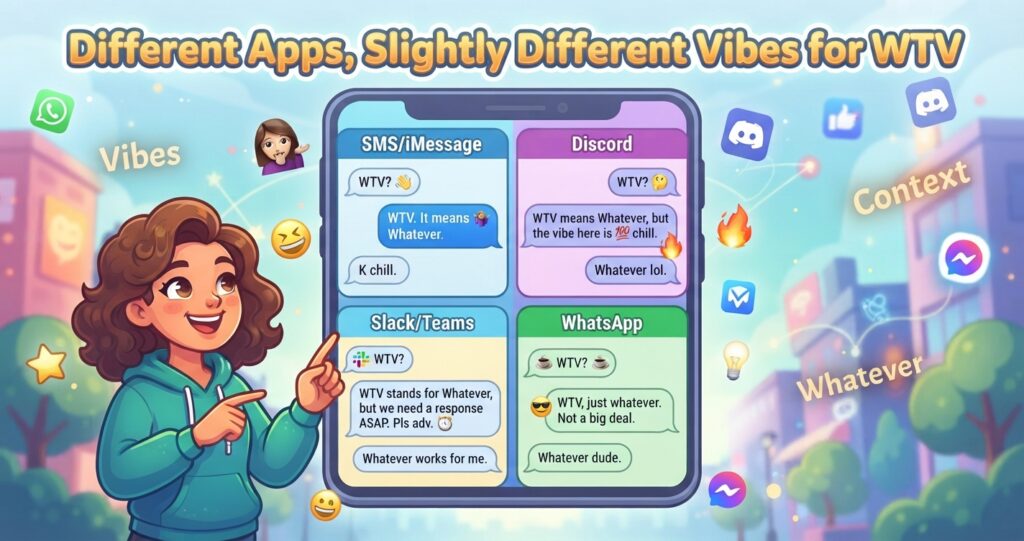
WTV mean in text generally keeps the same meaning across platforms. However, the surrounding culture can change how it feels.
Snapchat: WTV often appears in quick replies, casual conversations, and story interactions.
Instagram: People may use it in DMs, comments, captions, or reactions. It can express a carefree or dismissive attitude.
TikTok: WTV can appear in comments and casual conversations where short slang fits the fast-moving style of the platform.
Discord: Friends and gaming communities may use WTV as quick conversational shorthand.
Group chats: WTV often means “I don’t mind” when people are choosing food, movies, games, or plans.
Recent ranking pages also identify Snapchat, Instagram, TikTok, Discord, and messaging apps as common contexts for WTV.
The platform rarely changes the literal definition. The surrounding conversation changes the vibe.
Myths People Believe About WTV
Several assumptions about WTV can lead you in the wrong direction.
Myth 1: WTV always means someone is angry.
Not true. “WTV works for me” usually expresses flexibility rather than anger.
Myth 2: WTV always means “I don’t care about you.”
Again, context matters. Someone may simply have no preference about a choice.
Myth 3: WTV is automatically rude.
It’s informal, but informal doesn’t always mean disrespectful.
Myth 4: WTV has one emotional meaning.
It can sound neutral, playful, annoyed, dismissive, or resigned.
Myth 5: WTV always means “whatever.”
In ordinary texting, “whatever” is the dominant meaning. However, acronyms can have niche meanings in specific communities. Community slang references document other interpretations, which is why context still matters.
Smart Ways to Reply When You Get Hit With WTV
Your best reply depends on what the sender seems to mean.
If WTV sounds casual
Just move the conversation forward.
“Cool, let’s do tacos.”
There’s no need to overanalyze a harmless response.
If WTV feels cold
Check in without turning the exchange into a courtroom investigation.
“You good?”
That gives the other person room to explain.
If WTV appears during an argument
Don’t immediately fire back with another sarcastic message.
Instead, give the conversation some breathing room. Later, you can say:
“Can we talk about this when we’re both calmer?”
If you’re genuinely confused
Ask directly.
“When you said WTV, did you mean you don’t mind or you’re upset?”
A simple question can clear up more confusion than ten minutes of guessing.
Questions You’re Probably Still Asking About WTV
Is WTV always rude or disrespectful?
No. WTV mean in text is “whatever,” and it can sound perfectly neutral when someone has no preference. Context determines whether it feels rude.
Can it be sarcastic?
Yes. Friends can use WTV sarcastically or playfully, especially with emojis or joking context. A tense conversation can make the same abbreviation sound much harsher.
Does it mean the same thing on every app?
Usually, yes. WTV generally means “whatever,” but the surrounding platform culture and conversation can affect its tone.
What if I can’t tell if someone’s mad?
Look at the conversation before WTV mean in text . A sudden shift to short replies, missing emojis, or colder language can suggest frustration.
Should I use it with my parents or teachers?
Usually, avoid it in formal or respectful conversations. Say “either works for me” or “I don’t have a preference” instead.
Is there a difference between “wtv” and “w/e”?
Both can mean “whatever.” W/E is another informal abbreviation, while WTV mean in text uses the first three letters of “whatever.” Dictionary.com also lists W/E as an abbreviation connected with “whatever.”
Read More : OTT Meaning: What It Really Means in Texts, Streaming, and Everyday Life
The Real Takeaway on Reading WTV in Texts
WTV usually means “whatever,” but the tone depends on context.
It can mean “you choose” when friends are making plans. It can show indifference when someone doesn’t care about the outcome. During an argument, however, it may signal frustration or a desire to stop talking.
That’s why you shouldn’t judge the entire message from three letters.
Look at the relationship. Read the messages around it. Notice punctuation, emojis, and changes in texting style. Most importantly, consider what happened immediately before the sender wrote WTV mean in text .
And if the meaning still isn’t clear, ask.
Sometimes “You good?” solves a mystery that overthinking never will.