The SFLR Meaning usually means “Sorry For Late Reply.” People use this texting abbreviation when they respond later than expected and want to acknowledge the delay before continuing the conversation.
You might see it at the beginning of a text, DM, group chat message, or social media reply. For example, someone might write, “SFLR, I was at work all day.”
In some contexts, SFLR can also mean “Sorry For Late Response.” The intended idea stays the same: the sender is apologizing for taking too long to answer.
You Saw Those Four Letters and Had No Clue
Seeing sflr meaning for the first time can feel like stumbling across a secret code. Four letters appear at the start of a message, and suddenly you’re wondering what they mean.
Luckily, the answer is simple.
SFLR stands for “Sorry For Late Reply.”
The abbreviation helps people acknowledge a delayed response without typing the entire phrase. It works much like other texting shortcuts such as BRB, TTYL, or IDK.
For example:
“SFLR! I just got home. How did your interview go?”
Here, the sender isn’t making a dramatic apology. They’re simply recognizing that they took a while to respond.
That’s an important distinction. SFLR usually signals courtesy rather than deep remorse. The sender knows the reply came late and wants to smooth over that little communication gap.
You may also see lowercase forms such as “sflr meaning.” Capitalization doesn’t change the meaning.
What’s Really Happening When Someone Sends This
When someone sends SFLRsflr meaning, they’re doing more than expanding an abbreviation. They’re managing the social side of delayed communication.
Think of it as a quick conversational reset.
Someone disappears from a chat for several hours or days. When they finally return, saying “SFLR” lets them acknowledge the gap and move forward.
For example:
“SFLR, work was crazy today. Are you still free tonight?”
The sender gives a brief nod to the delay and then gets back to the actual conversation.
SFLR can communicate several things at once:
- Acknowledgment: “I know I replied late.”
- Courtesy: “I realize you may have been waiting.”
- Apology: “Sorry about the delay.”
- Conversation reset: “Let’s continue from here.”
- Informality: “I’m keeping this casual.”
The exact tone depends heavily on the relationship.
If a close friend sends “SFLR lol,” you probably won’t read it as a serious apology. If a coworker sends it after ignoring an important request, you may interpret it differently.
That context gives the abbreviation its real meaning.
Read More : What Does BYW Meaning? Is It a Typo or Real Slang?
Where This Actually Pops Up in Your Messages
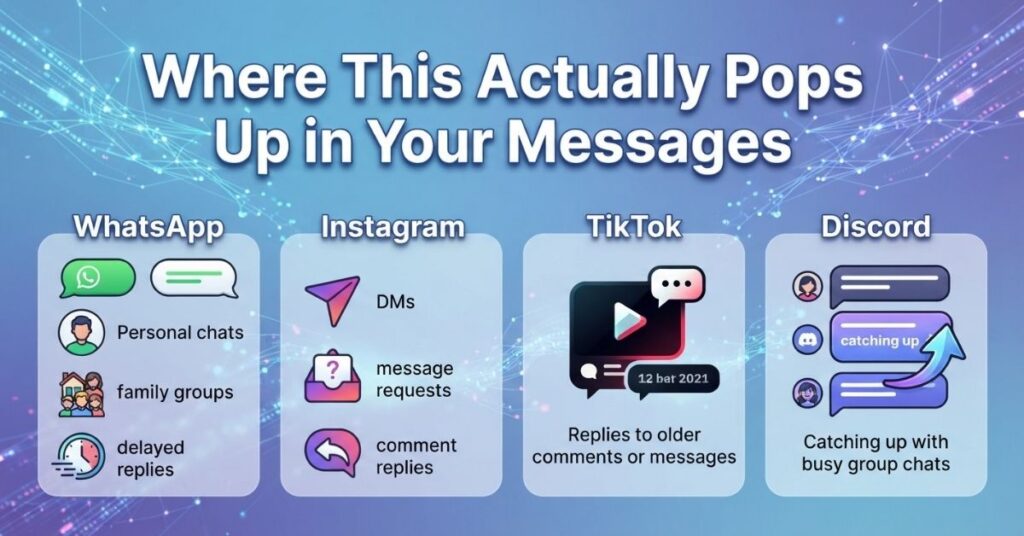
The sflr meaning can appear almost anywhere people communicate through text.
You’ll most commonly encounter it in personal chats, direct messages, and group conversations. Definition databases also identify it specifically with texting and online messaging.
Here are some common places to see it:
| Platform or setting | How SFLR may appear |
|---|---|
| Personal chats, family groups, and delayed replies | |
| DMs, message requests, and comment replies | |
| TikTok | Replies to older comments or messages |
| Discord | Catching up with busy group chats |
| Telegram | Personal and group conversations |
| Messenger | Friends and family conversations |
| Group chats | Returning after missing several messages |
| Workplace chats | Occasional casual use with familiar coworkers |
On WhatsApp, for example, someone might return to a busy group chat and write, “SFLR everyone, what did I miss?”
Instagram can create another common situation. Someone might discover an old message request days later and respond, “SFLR! Just saw this.”
The abbreviation doesn’t require a specific delay. One person might use it after an hour, while another might wait several days.
There’s no official stopwatch for a “late reply.”
Why the Same Four Letters Hit Different Depending on the Situation
The sflr meaning doesn’t carry exactly the same emotional weight in every conversation. Your relationship with the sender, the subject of the message, and the length of the delay all matter.
Who you’re texting matters
With close friends, SFLR usually feels relaxed.
“SFLR 😂 I fell asleep. What’s up?”
Nobody expects a formal apology between friends. The abbreviation simply acknowledges the delay.
Dating conversations can be different. If someone repeatedly takes days to respond and starts every message with SFLR, the phrase may feel less like courtesy and more like a pattern.
In professional communication, context matters even more. A casual Slack message to a teammate can tolerate more slang than a formal email to a client.
The closer the relationship, the more casual SFLR generally feels.
This is where people usually mess up
The biggest mistake is treating sflr meaning as appropriate for every delayed message.
Imagine a friend sends you an urgent message about a serious personal problem. Two days later, replying with only “SFLR” could sound cold.
The problem isn’t the abbreviation itself. It’s the mismatch between the casual wording and the emotional weight of the situation.
The same principle applies at work. If your manager asks for an important document and you respond two days later with “SFLR,” the message may sound too informal.
In those situations, spelling out the apology gives your response more weight.
“Sorry for the delayed response. I just saw your message.”
That sounds clearer and more professional.
The situation changes everything
A delayed reply doesn’t automatically require an apology.
If you disappeared for three days, sflr meaning makes sense. If you took twenty minutes to answer while eating lunch, you probably don’t need it.
Frequency also changes how people interpret the phrase.
Using SFLR occasionally can sound thoughtful. Using it in every conversation can make it feel automatic.
Eventually, the abbreviation may stop sounding like an apology and start sounding like a routine excuse.
Times When SFLR Will Make Things Worse
SFLR works best when the conversation is casual. In more serious situations, plain language usually wins.
Avoid relying on SFLR when:
- Someone shared serious or upsetting news.
- The other person needs urgent help.
- You’re responding to an important professional request.
- You’re writing a formal business email.
- You’re applying for a job.
- You’re speaking to someone who may not understand texting slang.
- You’re already arguing with the person.
- The delay created a significant problem.
For formal communication, try “Sorry for the delayed response” or “Apologies for the delay.”
Those phrases sound professional without feeling stiff.
A useful rule is simple: match the apology to the importance of the conversation.
If the conversation is light, SFLR can work. If the conversation carries real consequences, write the apology out.
Other Ways to Say You’re Replying Late
Sometimes sflr meaning doesn’t fit your tone. Fortunately, you have plenty of alternatives.
Casual
- “Sorry, just saw this.”
- “My bad, I missed your message.”
- “Just getting back to you.”
- “Been offline for a bit.”
- “Sorry I took so long to reply.”
Polite
- “Sorry for the delay.”
- “Sorry for not replying sooner.”
- “I just saw your message.”
- “Apologies for the late response.”
Professional
- “Apologies for the delayed response.”
- “Thank you for your patience.”
- “Sorry for the delay in getting back to you.”
- “I appreciate your patience while I reviewed this.”
Playful
- “SFLR, my phone and I clearly needed some space.”
- “Better late than never, right?”
- “SFLR 😂 I disappeared into the real world.”
The best option depends on who you’re talking to. You wouldn’t normally write a formal business apology to your best friend.
What It Looks Like When Real People Actually Type It

Seeing sflr meaning in real messages makes its meaning much easier to understand.
Here are natural examples:
With a friend:
“SFLR! I was out all afternoon. Wanna grab dinner?”
After missing a group chat:
“SFLR everyone. I just opened the chat. What happened?”
On Instagram:
“SFLR, I didn’t see your DM until today.”
In a casual dating conversation:
“Hey, SFLR. Work got hectic yesterday. How’s your week going?”
After falling asleep:
“SFLR lol, I knocked out.”
When replying to an old message:
“SFLR! I completely missed this. Are you still looking for tickets?”
Notice something important. SFLR usually doesn’t stand alone for long. The sender often follows it with an explanation, answer, question, or continuation of the conversation.
That makes the message feel more natural.
Read More : What Does PPL Full Form in Chat? The Casual Shortcut Acronym
Where This Term Lives Online (and Who Uses It Most)
SFLR belongs mainly to the world of informal digital communication.
You’ll find it in texting, direct messages, online chats, and social media conversations. Older abbreviation references also classify it specifically under texting terminology.
Its use isn’t limited to one social network. People may use it wherever delayed replies are part of normal conversation.
Younger users who regularly communicate through messaging apps may recognize the abbreviation quickly. However, not every internet user knows it.
That’s why context matters.
If you’re messaging someone who rarely uses slang, “Sorry for the late reply” is safer and clearer.
SFLR also isn’t a word you’d normally pronounce as one unit. It functions as an initialism, meaning you read the letters individually: S-F-L-R. Its main purpose is convenience in written communication.
There’s another important detail for anyone researching the abbreviation today. SFLR isn’t exclusively a texting term. It is also the ticker symbol for the Innovator Equity Managed Floor ETF, which trades on NYSE Arca. That financial meaning has nothing to do with texting.
So, if you see SFLR in a message, the surrounding conversation is what tells you which meaning applies.
The Mix-Ups That Keep Happening
SFLR looks simple, but a few misunderstandings come up repeatedly.
First, people sometimes assume that SFLR proves the sender was genuinely busy. It doesn’t.
Someone might have been working, sleeping, traveling, or simply forgotten to respond. The abbreviation acknowledges the delay, but it doesn’t explain why the delay happened.
Second, SFLR isn’t necessarily a serious apology.
Between friends, it may function almost like a conversational courtesy.
Third, people sometimes confuse SFLR with SLR. These abbreviations have essentially the same texting purpose. SLR is a shorter form used for “Sorry, Late Reply” or “Sorry, Late Response.”
Finally, don’t assume everyone understands SFLR. Internet slang changes quickly, and abbreviations can feel obvious to frequent texters while looking completely mysterious to everyone else.
When clarity matters, spell it out.
Questions People Actually Ask About This
Is SFLR rude to use?
Usually not. It sounds casual and polite in everyday texting, but it can feel dismissive in serious or formal conversations.
Can I use it sarcastically?
Yes. People can use SFLR jokingly when replying extremely late, such as after several weeks or months.
Does everyone know what SFLR means?
No. Frequent texters may recognize it immediately, but people unfamiliar with texting slang may not understand it.
What if I only waited an hour?
You can use it, but you probably don’t need to. SFLR works better when the delay actually feels noticeable.
Is it the same as SLR?
Almost. Both abbreviations communicate an apology for replying late, although SFLR spells out the phrase more fully.
Will people think I’m making excuses?
Not necessarily. A single SFLR usually sounds courteous, but repeated use without better communication can start to feel like an excuse.
Read More : 250+ Funny MMO Names That’ll Make Your Squad Laugh
Bottom Line
SFLR means “Sorry For Late Reply.” In some references, you’ll also see the closely related expansion “Sorry For Late Response.”
People use it to acknowledge that they took longer than expected to answer. You’ll mostly see it in casual texts, DMs, group chats, and social media conversations.
The key isn’t knowing the abbreviation. It’s knowing when it fits.
Use SFLR with friends when you want a quick, friendly acknowledgment. In serious or professional situations, write a clearer apology instead. And if someone sends you SFLR, you can usually read it as a simple signal that says, “Sorry I took so long to get back to you.”
One final detail is worth remembering: SFLR can also refer to a financial ticker symbol, so context always matters. In texting, though, those four letters almost certainly mean Sorry For Late Reply.