Ever opened someone’s profile for a quick look, then kept scrolling for twenty minutes? You checked their bio, old posts, tagged photos, and maybe even their highlights. Suddenly, that “quick look” became a full profile investigation. That’s where OSNS meaning comes in. OSNS stands for “One Second Not Stalking.” It’s a playful internet phrase people use when they admit they were lurking. Instead of sounding serious, it adds a little humor to the situation.
You’ll often spot OSNS in text messages, group chats, and private DMs. It also appears on Instagram, Snapchat, and TikTok. The phrase usually has a playful tone and a touch of self-aware humor. Someone might write “OSNS 👀” after checking a person’s profile. With friends, it can be funny and harmless. However, the same phrase may feel awkward with strangers. Context, timing, and familiarity all matter.
What Does OSNS Mean in Text?
OSNS meaning is usually “One Second Not Stalking.” It’s playful internet slang used when someone admits they checked another person’s profile. The phrase makes profile-checking sound quick and harmless.
In real conversations, OSNS often describes lurking, scrolling, or checking someone’s posts. It can also refer to checking bios, tagged photos, or Instagram highlights.
The funny part is the phrase itself. “One second” suggests a tiny glance, even when someone spent much longer looking.
You may see OSNS when someone:
- Checks an old post
- Looks through tagged photos
- Watches someone’s story
- Checks their highlights
- Falls into a rabbit hole scrolling
- Shares a screenshot with a friend
Conversation example:
Friend: “Why were you looking at his profile?”
You: “OSNS 👀”
Here, the speaker jokingly admits they were looking without making the situation feel serious.
You Saw It and Now You’re Lost
Seeing OSNS for the first time can feel confusing. The letters don’t immediately reveal their meaning. Unlike common terms such as LOL or IIRC, OSNS isn’t instantly familiar to everyone.
If someone sends “OSNS 👀,” they usually aren’t talking about technology or formal communication. They’re making a joke about checking someone’s social media profile.
The surrounding conversation gives you the biggest clue. Look at what happened immediately before the acronym appeared.
For example, someone might mention an ex, crush, celebrity, or mutual friend. Another person then says “OSNS.” That usually means they went looking at that person’s profile.
Think of it this way:
- OSNS = “I checked their profile.”
- Lurking = Looking around without interacting.
- Scrolling = Moving through posts or content.
- Profile investigation = Looking at several parts of someone’s account.
So, if you were wondering about osns meaning, context usually makes the answer much easier.
Read More : What Does KMS Meaning Text? The Truth Behind Those 3 Letters
What “OSNS” Actually Says About Online Behavior
OSNS says more about online habits than people realize. Social media makes it incredibly easy to become curious about someone. One profile can quickly lead to another post, another photo, and another tagged account.
That’s where the joke comes from. Someone might claim they looked for “one second” after spending ten minutes exploring a profile.
The phrase combines humor with mild embarrassment. It lets people admit guilt without making the situation uncomfortable.
OSNS can suggest:
- Curiosity about someone
- Casual profile-checking
- Late-night scrolling
- Rabbit hole scrolling
- Self-aware humor
- Embarrassment avoidance
- A playful guilt admission
For example:
Friend: “Did you seriously check her old photos?”
You: “OSNS 😂”
The reply admits what happened while keeping the mood light.
Still, OSNS doesn’t automatically mean serious social media stalking. In most casual conversations, it describes ordinary online curiosity.
Where You’ll Spot “OSNS” Popping Up
OSNS usually appears where people communicate quickly. Text messages, group chats, and private DMs are common places to see it.
Instagram is especially suitable because users can easily browse posts, captions, likes, followers, stories, and highlights. Snapchat and TikTok also create plenty of opportunities for profile-checking.
You might even see the phrase after someone shares a screenshot.
Common places include:
- Instagram DMs
- Snapchat conversations
- TikTok messages
- Group chats
- Private DMs
- Text messages
- Social media comments
Conversation example:
Friend: “I wonder what happened to Jake.”
You: “OSNS 👀”
Friend: “You already checked his page?”
You: “Maybe.”
That exchange shows the casual nature of the term. It doesn’t need a long explanation.
However, you probably won’t see OSNS in formal captions, business emails, or serious work communications. It belongs mainly to informal communication and online youth culture.
Why Context & Tone Changes Everything with “OSNS”
Tone can completely change how OSNS feels. With a close friend, it may sound funny and relatable. With a stranger, the same phrase could sound uncomfortable.
The playful tone usually depends on familiarity. Friends understand the self-roasting humor behind the expression. They know the speaker isn’t making a serious confession.
Sarcasm can also shape the meaning. Someone might say “OSNS” after clearly spending an hour scrolling through someone’s account.
Context matters most in:
- Flirting contexts
- Private DMs
- Group chats
- Public comments
- Family chats
- Venting conversations
- New friendships
Example:
Friend: “Did you check my new boyfriend’s page?”
You: “OSNS 👀”
That sounds playful between friends.
Now imagine sending it to someone you barely know. They might wonder why you’re watching their profile. In that situation, the joke could create awkwardness instead of laughter.
Good social media etiquette means reading the room before using slang.
Places Where “OSNS” Falls Flat (Don’t Go There)
OSNS works best when the conversation already feels relaxed. Put it in the wrong setting, and the joke can fall flat quickly.
Work communications are one obvious example. Your coworker might understand the slang, but a professional message isn’t the right place for profile-stalking jokes.
Serious conversations also need care. If someone is venting about a personal problem, replying with OSNS may seem dismissive.
Use caution with:
- Work communications
- Professional DMs
- Serious discussions
- Sensitive family chats
- Public comments
- Strangers
- People with boundary issues
For example:
Coworker: “Did you review the client update?”
You: “OSNS 😂”
That response doesn’t fit the situation.
Instead, save OSNS for casual communication where both people understand internet speak fluency. A little familiarity can make the difference between funny and awkward.
Other Ways to Admit You Were Looking
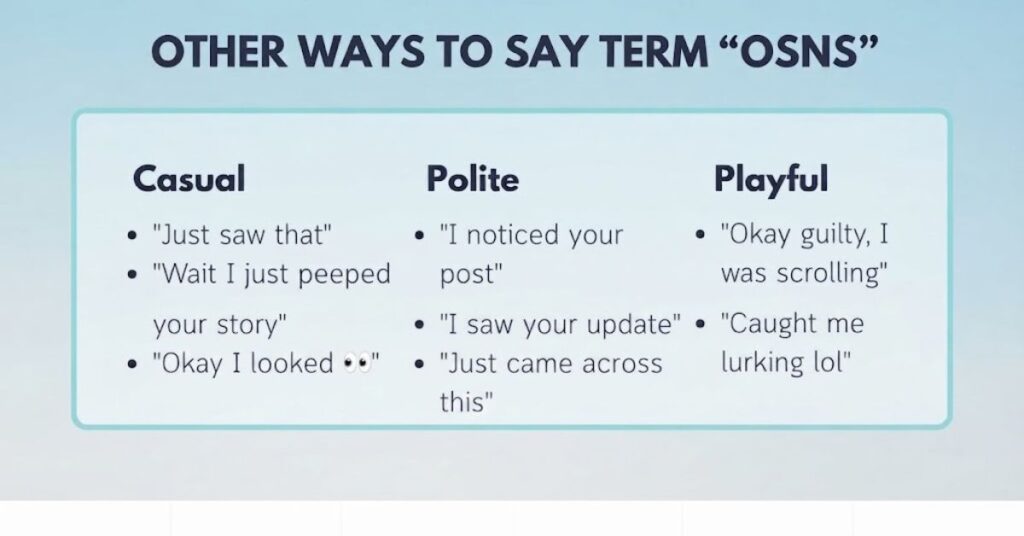
Sometimes you don’t need OSNS at all. A simple phrase can communicate the same idea without relying on internet slang.
Your choice depends on the person, setting, and tone. Friends may enjoy playful wording. A professional contact needs something much clearer.
Casual alternatives include:
- “I was lurking.”
- “Caught me scrolling.”
- “I checked your page.”
- “I was being nosy.”
- “I went down a rabbit hole.”
- “I just peeped your story.”
- “Okay, I looked 👀”
Conversation example:
Friend: “How did you know about that old photo?”
You: “I was lurking, okay? 😂”
For professional situations, choose a cleaner phrase:
“I came across your post.”
Or:
“I noticed your update.”
These alternatives help you avoid confusion. They also work better when the other person doesn’t understand slang.
OSNS has a specific playful flavor. However, plain language often works just as well.
Read More : What Does PAB Meaning Slang? The Answer Depends on Where You Saw It
Example Messages People Actually Send “OSNS”
Examples make slang much easier to understand. OSNS usually appears as a short reaction rather than a formal sentence.
People may type it after discovering something interesting on someone’s profile. They might also use it after checking an ex’s new partner or a friend’s old photos.
Here are some natural examples:
“OSNS 👀 your vacation photos are actually cute.”
“I was OSNS and found your old account 😂”
“OSNS for like five minutes. Why didn’t you tell me?”
“Okay, OSNS. Who is that person?”
“Me: OSNS. Also me: checking every tagged photo.”
“OSNS on her page and now I know too much.”
The acronym can appear alone, too.
Friend: “Did you check his new profile?”
You: “OSNS 😂”
That short response works because both people already understand the context.
The humor comes from pretending the profile investigation took only one second.
App Culture and Where This Term Lives
OSNS fits naturally into fast-moving social media culture. Apps like Instagram, TikTok, and Snapchat encourage quick browsing and constant profile-checking.
Instagram offers posts, stories, highlights, captions, likes, and tagged photos. TikTok makes rabbit hole scrolling almost effortless. Snapchat also encourages frequent story viewing and private conversations.
Twitter/X has its own internet culture where self-roasting and sarcasm often thrive. Facebook and LinkedIn are less likely places for this slang, especially in professional spaces.
You may encounter OSNS around:
- Instagram stories
- TikTok profiles
- Snapchat stories
- Twitter/X posts
- Facebook profiles
- LinkedIn profiles
- Private DMs
- Group chats
Age can influence familiarity, too. Gen Z and younger millennials may recognize online slang more quickly. Someone in the thirties age group may know it, but they might not use it regularly.
That doesn’t make OSNS exclusive to one generation. Internet culture changes fast, and slang travels across platforms.
Misreading “OSNS”: Common Mix-Ups Explained
OSNS can cause confusion because internet slang changes quickly. Some readers may also mistake it for another acronym.
The most important distinction involves ONS. ONS commonly means “one night stand,” which has a completely different meaning. Adding the second S changes everything.
OSNS can also appear in non-slang contexts. For example, someone researching technology may encounter terms related to online social networks.
Don’t automatically assume OSNS means slang. Check the context.
- OSNS: One Second Not Stalking
- ONS: Often means one night stand
- IIRC: If I recall correctly
- YW: You’re welcome
- WTV: Whatever
- NM: Not much or never mind
Other slang terms such as BOT, IGH, GMS, TOTM, MFS, DF, CS, OTG, OSRS, BGC, BSFS, STTM, PAB, and ISG can also confuse readers when they appear without context.
The safest approach is simple. Look at the words around the acronym before deciding what it means.
Your Burning Questions About “OSNS” Answered
OSNS may look simple, but slang often creates follow-up questions. People want to know how the phrase works, when to use it, and whether it sounds strange.
The short answer is that OSNS belongs mainly to casual online communication. It works best when the conversation already has a relaxed tone.
You can use it with friends, especially when you’re joking about checking someone’s profile.
Quick guide:
- Meaning: One Second Not Stalking
- Style: Informal internet slang
- Tone: Usually playful
- Common use: Profile-checking and lurking
- Best setting: Casual conversations
- Less suitable: Professional or serious discussions
It can also work during playful flirting. Still, familiarity levels matter.
If you’re unsure whether someone understands the phrase, use clearer wording. Saying “I checked your profile” leaves less room for confusion.
Is it rude to say this?
Usually, OSNS isn’t rude between close friends. The phrase often carries self-aware humor rather than genuine criticism.
However, context can change everything. Someone you barely know may not find the joke funny. They could interpret it as an unwanted admission of social media stalking.
For example:
Friend: “You checked my profile?”
You: “OSNS 😂”
That sounds harmless between friends.
But saying it to a stranger could create discomfort. Boundary issues also matter. If someone has already expressed concern about being watched online, don’t use OSNS as a joke.
Social media etiquette matters here. When in doubt, choose a simple and respectful response.
Can it sound sarcastic?
Yes, OSNS can definitely sound sarcastic. The humor often comes from saying something that clearly isn’t completely true.
Someone might claim “one second” after spending twenty minutes scrolling through posts. That contrast creates the joke.
Example:
Friend: “How did you know about her old vacation?”
You: “OSNS. Totally one second. 😂”
The speaker obviously looked longer than that. The sarcasm adds a layer of self-aware nonchalance.
This style of self-roasting is common in online youth culture. People exaggerate their innocence while openly admitting guilt.
Still, written sarcasm can be tricky. Without emojis or surrounding context, someone may misunderstand your tone.
Read More : What Does TTG Mean in Text? The Complete Guide to TTG Meaning
Do people say this out loud?
OSNS mainly belongs to written communication. People usually type it rather than pronounce each letter during everyday conversations.
You might see it in text messages, DMs, comments, or group chats. Saying “O-S-N-S” aloud would probably sound unusual to many people.
Instead of saying:
“OSNS.”
People usually say:
“I was checking their profile.”
Or:
“I was just lurking.”
The written form works because internet slang saves time and adds personality. Similar abbreviations such as IIRC and YW also make digital conversations quicker.
That doesn’t mean nobody can say OSNS aloud. Internet language constantly moves between screens and real life.
However, you’ll usually understand the phrase better when you see it typed.
Does it mean the same thing everywhere?
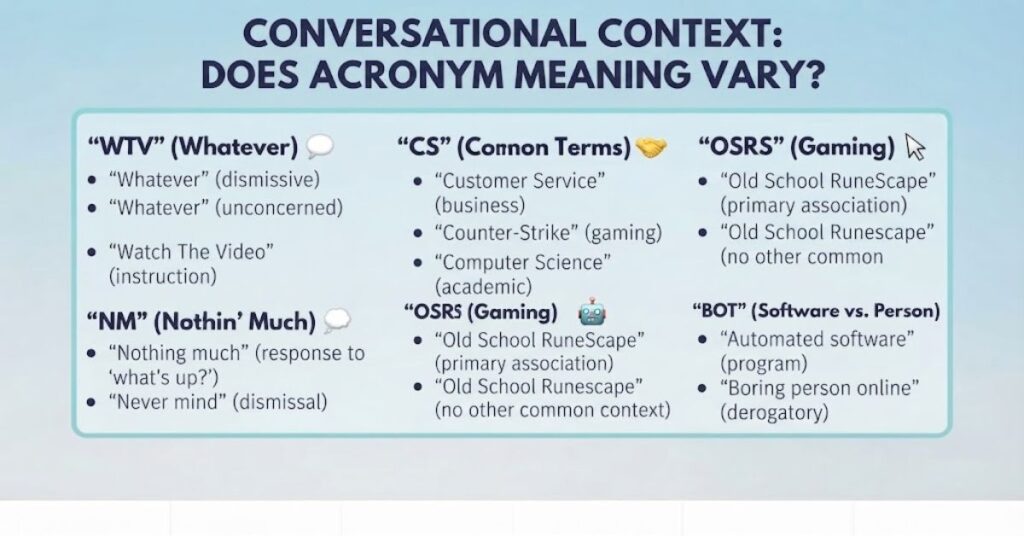
Not always. OSNS usually means “One Second Not Stalking” in casual social media conversations. Still, acronyms can have different meanings in different fields.
Context remains your best clue. A message from a friend probably points toward internet slang. A technical document may use OSNS differently.
The same principle applies to many abbreviations.
For example:
- WTV can depend on the conversation.
- NM can mean different things.
- CS has several common interpretations.
- OSRS is often associated with gaming.
- BOT can describe software or a person online.
Age and platform can also influence familiarity. Gen Z, younger millennials, and other frequent social media users may recognize OSNS faster.
So, don’t judge an acronym by the letters alone. Read the surrounding message.
Is it just for Instagram?
No. OSNS isn’t limited to Instagram. The phrase can describe profile-checking across many social platforms.
Instagram may be a natural home for it because users often browse profiles, stories, highlights, posts, captions, and tagged photos. Still, the same joke can work on TikTok, Snapchat, Twitter/X, Facebook, or even LinkedIn.
For example:
“OSNS on TikTok and now I’m three hours deep.”
Or:
“OSNS on Snapchat 👀”
The meaning stays basically the same.
However, the platform changes how natural the phrase feels. Instagram, TikTok, and Snapchat generally fit informal internet speak better than LinkedIn.
Ultimately, OSNS describes an online behavior rather than one specific app. Wherever people have profiles, scrolling, and curiosity can turn into a little digital rabbit hole.