Ever received an “AYO” message and thought, “Wait, what does that mean?” You’re not alone. This small word can carry several meanings in a text conversation. Sometimes, it’s a friendly greeting like “hey” or “yo.” Other times, it signals surprise, confusion, or a quick double-take. The punctuation matters too. “AYO!” can show excitement, while “AYO?” may sound suspicious or questioning. Your context and tone often reveal the real ayo meaning in chat.
You’ll spot AYO across internet slang and Gen Z slang. It pops up on TikTok, Instagram, Snapchat, Discord, and group chats. A friend might text, “Ayo, what’s up?” But after a strange comment, someone might fire back, “AYO? 🤨” That reaction feels like an instant eyebrow raise. AYO isn’t usually an acronym. You may also see “Eyo” or “Aye-yo” in casual spoken slang.
You’re Here Because Something Felt Off
You saw “AYO” in a text and stopped for a second. Maybe it was a simple greeting. Maybe it sounded like a reaction. That’s where the confusion begins.
The ayo meaning in chat changes with the situation. AYO can mean “hey,” “yo,” or “what’s up?” It can also show surprise when someone says something strange.
Think of AYO as a verbal eyebrow raise. The word stays the same, but the feeling can change.
- “Ayo, what’s up?” → friendly greeting
- “AYO! That was amazing!” → excitement
- “Ayo? 🤨” → suspicion or confusion
- “Ayo 💀” → disbelief or amusement
Your relationship with the sender matters too. A friend may use it casually. A stranger might use it to react to something unexpected.
Example:
You: “I finished the whole pizza myself.”
Friend: “AYO? 💀”
Here, the friend isn’t greeting you. They’re reacting to what you said.
Breaking Down What’s Really Happening
AYO usually plays two major roles in casual communication. It can start a conversation, or it can react to one.
As a greeting, AYO works like “hey” or “yo.” You might use it before asking a question. It feels relaxed and friendly.
As a reaction, it becomes more expressive. Someone may use it after hearing something weird, funny, shocking, or slightly suspicious.
- Greeting: “Ayo, you good?”
- Attention: “Ayo, look at this!”
- Surprise: “AYO! No way!”
- Suspicion: “Ayo? What was that?”
- Judgment: “Ayo 🤨, you really posted that?”
- Respect: “AYO! That was clean!”
Context does most of the heavy lifting. The words around AYO often reveal the intended meaning.
You may also see Eyo or Aye-yo. These versions can reflect spoken slang or personal spelling.
Read More : What Does WC Meaning in Text? The Real Answer
Real Conversations Where This Pops Up
AYO feels natural when people want quick reactions. You’ll often see it between friends, in group chats, or during casual text conversations.
A friend might use it to get your attention. Someone in a gaming circle might shout it after an incredible play. In a comment section, it can signal that something sounded questionable.
Here are a few natural situations:
- Greeting: “Ayo, you coming tonight?”
- Gaming: “AYO! That was insane!”
- Group chat: “Ayo, who has the notes?”
- Comment section: “Ayo? 🤨 What did he just say?”
- DMs: “Ayo, you still awake?”
- Reaction: “AYO 💀 That cannot be real.”
Conversation:
Friend: “I accidentally sent the screenshot to my boss.”
You: “AYO 💀”
The response shows surprise and amusement. It doesn’t mean “hello.”
That’s why the same word can feel completely different from one message to another.
Punctuation Changes Everything (Pay Attention Here)
Punctuation can change the mood of AYO. It isn’t a strict rule, but it gives you useful clues.
A question mark often makes the message sound confused or suspicious. An exclamation point usually adds energy. Ellipsis or dots can create an awkward or doubtful feeling.
- “Ayo!” → excitement or surprise
- “Ayo?” → confusion or suspicion
- “Ayo…” → concern or disappointment
- “AYO 😂” → amusement
- “AYO 🤨” → judgment or suspicion
- “AYO 💀” → disbelief or laughter
Conversation:
Friend: “I told her I was watching her sleep.”
You: “Ayo? 🤨”
The question mark makes the reaction sound like, “Hold on. What did you just say?”
Without punctuation, the meaning becomes more dependent on context. That’s why you should read the whole message instead of focusing on one word.
Skip This Word in These Situations
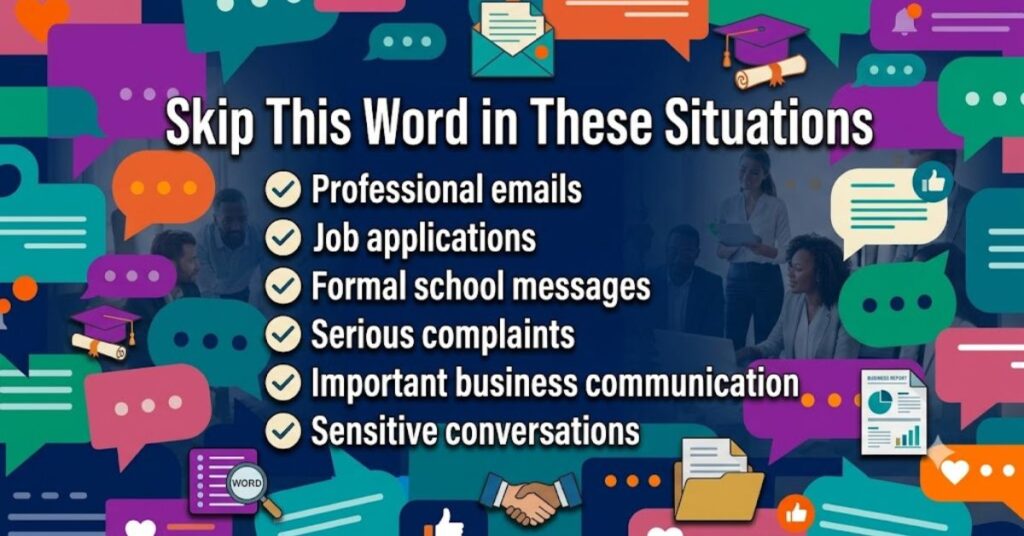
AYO works best in relaxed conversations. It can sound too casual in serious or professional settings.
You probably shouldn’t start a formal email with “Ayo.” The same applies to workplace messages when you don’t know the person well.
- Professional emails
- Job applications
- Formal school messages
- Serious complaints
- Important business communication
- Sensitive conversations
Better choice:
Instead of:
“Ayo, can you send the report?”
Use:
“Hi, could you send the report?”
Slack can be different. If you’re close with your coworkers, casual slang may fit your team culture. Still, know your audience.
Be careful with older family members too. Some may understand internet slang, while others may not.
If a romantic interest shares something serious, “Ayo?” could sound dismissive. In that moment, “Everything okay?” or “What’s going on?” is much safer.
Other Ways to Say the Same Thing
Not every situation needs AYO. Sometimes another phrase communicates your meaning more clearly.
For a simple greeting, try:
- Hey
- Yo
- Hi there
- Hello
- What’s up?
If you’re checking on someone, use:
- You good?
- Everything okay?
- What’s going on?
For a surprising message, you could say:
- Wait, what?
- Hold on
- Pause
- Excuse me?
- Okay but…
Conversation:
Friend: “I bought another pair of shoes.”
You: “Ayo, how many pairs do you have?”
You could also say:
“Wait, what? You bought another pair?”
Both work. AYO simply feels more casual and playful.
Related internet slang, such as HML or YHU, can also appear in casual texting. However, each slang term has its own meaning. Don’t treat them as direct replacements for AYO.
Read More : OTT Meaning: What It Really Means in Texts, Streaming, and Everyday Life
Example Messages People Actually Send
AYO can fit many everyday conversations. The trick is matching the expression to the situation.
Here are some natural examples:
- “Ayo, what’s up?” — casual greeting
- “Ayo, you good?” — checking on a friend
- “AYO! We actually won!” — excitement
- “Ayo? 🤨 What did you mean by that?” — suspicion
- “AYO 💀 You really posted that?” — amusement
- “Ayo, look at this!” — getting attention
- “AYO! That was clean!” — showing respect
- “Ayo… seriously?” — disappointment
Conversation:
Friend: “I forgot we had an exam today.”
You: “AYO 💀”
Or:
Friend: “Guess who just texted me?”
You: “Ayo 👀 Who?”
Here, the emoji adds curiosity. In some conversations, AYO can even feel playful or slightly flirty.
The surrounding words matter more than the slang itself. Always read the message as a whole.
Different Platforms, Different Vibes

AYO appears across many social platforms. However, its meaning doesn’t completely change from one app to another.
On TikTok, you may see AYO in comments when someone says something unexpected. The comment section often turns it into a shared reaction.
On Instagram, AYO can appear in DMs, Stories, and casual replies.
Snapchat users may use it in quick messages between friends. On Discord, gaming circles often use AYO after surprising plays or funny moments.
You may also see it in:
- TikTok comments
- Instagram DMs
- Snapchat messages
- Discord chats
- Group chats
- Slack conversations
- Social media posts
Example:
Discord: “AYO! Did you see that play?”
TikTok: “Ayo? 🤨”
The platform changes the setting. The basic tone still comes from context, punctuation, and the relationship between people.
Mistakes Everyone Makes With This One
The biggest mistake is assuming AYO always means “hello.” It doesn’t.
Another common mistake involves treating AYO like an acronym. In everyday internet slang, AYO usually isn’t an acronym with a fixed meaning for each letter.
People also confuse “Ayo?” with “Are you okay?” They aren’t automatically the same. Ayo may question what someone said instead.
Watch out for these mistakes:
- Assuming AYO always means “hey”
- Ignoring the question mark
- Missing sarcastic tone
- Using it in formal messages
- Thinking it always means flirting
- Treating it as an acronym
- Using it in every sentence
Example:
Friend: “I just ate six burgers.”
You: “Ayo?”
That’s probably surprise.
But:
Friend: “Ayo, want to grab food?”
That’s simply a greeting or attention-getter.
The safest approach is simple. Check the context first. Then look at the punctuation, emojis, and conversation around it.
Questions You’re Probably Wondering About “AYO” Slang
Can you use it with someone older than you?
Yes, if they understand internet slang and your relationship feels casual. Otherwise, use Hey or Hello instead.
Does it sound rude?
AYO isn’t usually rude, but tone matters. The ayo meaning in chat can sound judgmental when followed by a question mark.
Is there a difference when a girl vs guy uses it?
No, gender doesn’t change its meaning. Both girls and guys can use AYO as a greeting, reaction, or playful expression.
Can it be sarcastic?
Yes, AYO can sound sarcastic when paired with emojis or certain words. Your tone and context usually reveal sarcasm.
What if someone uses it and I don’t know which meaning they meant?
Check the previous message, punctuation, and emojis first. These clues usually show whether AYO means greeting, surprise, confusion, or judgment.
Do people still say this in 2026?
Yes, people still use AYO in casual chats, social media comments, gaming circles, and group conversations, especially among younger users.
Read More : SFLR Meaning: What It Means in Texts and Why People Use It
Conclusion
The ayo meaning in chat can change with the moment. Sometimes, AYO is a simple greeting like Hey or Yo. Other times, it shows surprise, confusion, excitement, or suspicion. Your tone, punctuation, emojis, and context help reveal the meaning. AYO? 🤨 can feel like a double-take. AYO! can show excitement. So, when you see AYO, read the whole message before replying.
Understanding the ayo meaning in chat helps you avoid awkward replies. In casual texts, AYO can sound friendly and playful. It works well with friends, group chats, gaming circles, and social media. However, formal messages need clearer words. If you’re unsure about the ayo meaning in chat, check what came before it. The ayo meaning in chat is not fixed. It depends on the conversation, the person, and the feeling behind the message. That word can say a lot.