
TMI meaning is “Too Much Information.” People use this informal abbreviation when someone shares more personal, embarrassing, uncomfortable, or unnecessary detail than the listener wants to hear. You may see TMI in texting, social media comments, DMs, group chats, and everyday conversations.
The interesting part is that TMI isn’t always harsh. Between close friends, it can be funny and playful. In a serious conversation, however, saying “TMI” can sound dismissive. Context, relationship, and tone make a big difference.
People Keep Seeing This and Getting Confused
If someone replies “TMI 😂” after your message, they probably aren’t asking for more information. They’re saying that you shared more than they needed or wanted to know.
For example:
“I haven’t slept because my stomach has been terrible all night.”
A friend might reply:
“TMI 😂”
The response usually means, “Okay, that’s more detail than I needed.”
TMI can refer to information that is:
- Too personal
- Embarrassing
- Gross or uncomfortable
- Intimate
- Unnecessary for the conversation
- Excessively detailed
The term is usually informal and conversational. Cambridge Dictionary defines TMI meaning as an abbreviation for “too much information” and describes its use when someone gives excessive details, especially personal information that may be embarrassing.
There is also an important distinction between sharing too much information and simply giving a long answer. A detailed explanation isn’t automatically TMI. The phrase usually appears when the information feels inappropriate, overly personal, awkward, or unnecessary for that particular audience.
The Real Feeling Behind “TMI” Meaning
TMI works like a small social warning.
When someone says “TMI,” they’re often communicating:
“I didn’t need to know that.”
It can also mean:
“Please stop with the details.”
Or, in a playful conversation:
“That was way too much, but I’m laughing.”
That’s why TMI can carry several emotions at once. The words themselves are simple, but the meaning depends heavily on delivery.
A close friend might say:
“TMI, bro 😂”
and continue the conversation.
Someone you barely know might say:
“Uh, TMI.”
That version can signal genuine discomfort.
People also use TMI before revealing something themselves. You might see:
“TMI, but I haven’t showered since yesterday.”
Here, the speaker already knows the detail might be unnecessary. Saying TMI makes the confession feel more self aware and sometimes more humorous.
In this sense, TMI isn’t always a criticism. It can be a way of acknowledging your own oversharing before someone else points it out.
Read More : Derek Mathewson Net Worth 2026: Inside the Bangers & Cash Star’s Wealth, Career, and Income Sources
Where You’ll Actually Spot This Term

TMI is common across informal digital communication.
TMI Meaning in Texting
In text messages, TMI usually appears as a quick reaction to something personal or awkward.
“My doctor found a rash in a very embarrassing place.”
“TMI 😭”
It can also appear at the beginning of a message:
“TMI but I almost fell asleep during the meeting.”
TMI on Instagram
On Instagram, people may use TMI in comments, captions, replies, and DMs. A person might write “TMI” after a friend shares an overly personal story.
TMI on TikTok
TikTok users may use #TMI or write “TMI” before a confession, embarrassing story, relationship detail, or personal experience. Current social media usage also shows that TMI can be used humorously rather than as a serious objection.
TMI on Snapchat
Snapchat conversations often involve casual, spontaneous updates. TMI can therefore appear when a friend shares an awkward, personal, or unnecessarily detailed story.
TMI in Group Chats
Group chats are another natural setting for the abbreviation.
One person may overshare, while everyone else reacts with:
“TMI!”
The meaning can be serious or completely playful depending on the group’s relationship.
Why TMI Meaning Hits Different Depending on Who Says It
The same three letters can feel completely different depending on the speaker.
With Close Friends
TMI is often playful. Friends may use it to tease each other without actually ending the conversation.
“So then my date started talking about his ex for 45 minutes.”
“TMI 😂”
Here, the phrase may simply mean, “Wow, that’s a lot.”
With Someone You Barely Know
TMI Meaning can be more serious. If someone you’ve just met responds this way, they may genuinely feel uncomfortable with the level of personal detail.
In Dating Conversations
Dating makes context especially important. Sharing a personal preference isn’t necessarily TMI, but discussing intimate bodily details during an early conversation may feel like oversharing.
During a Serious Conversation
This is where you should be careful.
If someone is discussing grief, illness, abuse, family problems, or another sensitive experience, immediately responding with “TMI Meaning ” can sound cold or dismissive.
The issue isn’t necessarily the amount of information. The emotional situation matters too.
When Used Sarcastically
TMI can even mean the opposite of what it appears to say.
A friend might say:
“TMI! Keep going.”
In that situation, the speaker may actually be encouraging the story. Emojis, punctuation, and the relationship between the people involved can help reveal the intended tone.
Places Where “TMI” Just Doesn’t Work
TMI is informal slang, so it isn’t appropriate in every situation.
Professional Communication
Avoid using TMI with a manager, client, customer, teacher, or formal business contact unless you already have an unusually casual relationship.
Instead of:
“TMI.”
try:
“I think we have enough detail for now.”
or:
“Let’s keep the discussion focused on the main issue.”
Current guidance on workplace communication also emphasizes that TMI is better suited to informal social conversations than formal professional communication.
Sensitive Personal Situations
Be careful when someone is discussing:
- A medical problem
- Bereavement
- Mental or emotional distress
- Relationship problems
- Family difficulties
- A traumatic experience
Even if the person provides a lot of detail, they may be looking for support rather than criticism.
Formal Writing
TMI generally doesn’t belong in academic writing, formal reports, professional emails, or official documents. Use precise language instead.
Other Ways to Say “That’s Too Much” Without Using “TMI Meaning ”
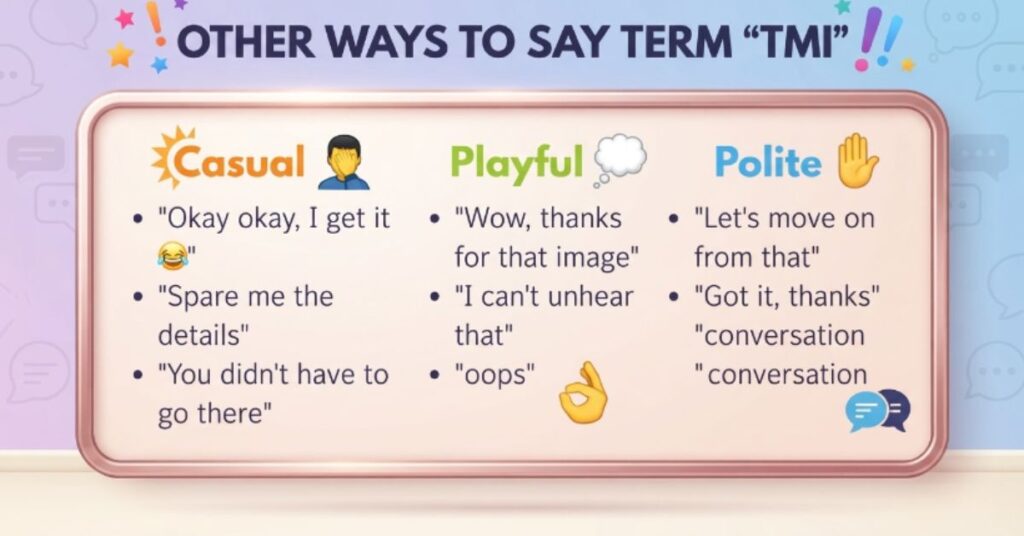
Sometimes you want to communicate the same idea without using slang.
Casual and Friendly
- “Okay, I didn’t need that detail.”
- “Spare me the details.”
- “You didn’t have to go that far.”
- “That’s more than I needed to know.”
- “Okay, that’s a lot.”
Polite
- “I think that’s more detail than we need.”
- “Let’s keep it a little more general.”
- “We can move on from that.”
- “I understand. No need for the extra details.”
Playful
- “I can’t unhear that.”
- “Why did you tell me this?”
- “My brain didn’t need that image.”
- “You really went there.”
The best alternative depends on whether you’re trying to sound funny, respectful, concerned, or firm.
Read More : Glenn Medeiros Net Worth: Career, Earnings & Lifestyle
Actual Texts People Send (TMI Meaning Edition)
Here are realistic examples of how TMI can appear in everyday conversations.
Friend oversharing:
“I spent the whole night talking about my breakup and then cried over an old photo.”
“TMI, but I respect the honesty 😂”
Self aware confession:
“TMI but I haven’t cleaned my room in two weeks.”
Group chat reaction:
“My date told me every detail about his last relationship.”
“TMI. We didn’t need the full documentary.”
Social media comment:
“Why would you tell us exactly what happened in the bathroom? TMI 😭”
Playful use:
“TMI, but I still check my ex’s profile sometimes.”
Dating conversation:
“We’ve only been talking for two days and you’re already telling me all of that?”
“Okay… TMI.”
These examples show why the abbreviation is more about context and comfort than a fixed amount of information.
TMI Means Something Totally Different on TikTok and in K-Pop Spaces
The most common meaning of TMI remains “Too Much Information.” However, online communities can use the same abbreviation differently.
On TikTok, Instagram, and other social platforms, TMI can introduce an embarrassing confession or personal detail. Someone might write:
“TMI, but I overthink every text before sending it.”
In this case, the person isn’t necessarily warning others to stop reading. They’re making the confession sound more casual and self aware. Current social media explainers show this playful use in captions, comments, and DMs.
K pop fan communities provide a notable alternate context. “TMI” can refer to a random personal fact or fun piece of information about an idol, rather than information that is inappropriate or uncomfortable.
For example, a fan might ask for someone’s “TMI of the day” and expect something simple such as what they ate, watched, or did that day.
So, if you see TMI in a K pop context, don’t automatically assume it means “stop oversharing.” The surrounding conversation tells you which meaning applies.
Misreading TMI Meaning: Why This Gets Awkward Fast
One of the easiest mistakes is assuming that TMI is always rude.
It isn’t.
The abbreviation can be:
- Funny
- Friendly
- Sarcastic
- Teasing
- Uncomfortable
- Dismissive
- A genuine request to change the subject
Tone is especially difficult to read in text because you can’t hear someone’s voice or see their facial expression.
An emoji can soften the message:
“TMI 😂”
Without an emoji, the same message may feel more direct:
“TMI.”
Another mistake is confusing TMI with NSFW.
They aren’t the same.
TMI generally refers to excessive, personal, embarrassing, or unnecessary information. NSFW, meaning “not safe for work,” is a broader warning that content may be inappropriate to view in a workplace or other public setting.
A conversation can be TMI without being NSFW. Likewise, something can be NSFW without involving personal oversharing.
The safest approach is to consider the person, topic, relationship, and setting before using the abbreviation.
Quick Answers About Using “TMI” in Texts
Is saying TMI rude?
Not necessarily. With close friends it can be playful, but with strangers or during sensitive conversations, it may sound dismissive.
Can TMI be sarcastic?
Yes. Friends sometimes say “TMI” jokingly when they actually want the person to continue the story.
Does it mean the same thing everywhere?
No. “Too Much Information” is the standard meaning, but some online communities, including K pop fandoms, use TMI for fun personal facts.
When did people start using TMI?
The abbreviation has been traced to the late 1980s, while its broader popularity grew through online communities and internet culture in the 1990s and 2000s.
Can you use TMI in professional emails?
Generally, no. TMI is informal slang, so clearer professional wording is usually better.
What if someone says TMI to me and I didn’t mean to overshare?
Don’t overthink it. You can simply say “My bad” or “Sorry, I got carried away” and move the conversation to another topic.
Read More : Dan Schneider Net Worth: How the TV Legend Built $40M
Last Thing to Know About “TMI”
TMI means “Too Much Information,” but the real meaning depends on context. It’s commonly used when someone shares personal, embarrassing, intimate, or unnecessary details, especially in texts and social media conversations.
The phrase can be a genuine boundary, a friendly joke, or a sarcastic reaction. Before using it, think about who you’re talking to and what they’re discussing.
If you’re chatting with a close friend, “TMI 😂” may get a laugh. If someone is opening up about a serious problem, listening is usually the better response.
In short, TMI isn’t really about the number of details someone shares. It’s about whether those details feel like more information than the audience wanted, expected, or was comfortable receiving.